Sunday, April 27, 2025

Commit Acts of Art: Finding Old Sketchbooks

 "Not every act of art creates something special, but it does create something. It is the act of art that is important, not the result." Michael L. Goodman

It is said that anyone who can read cannot clean out the attic. Too many opportunities to sit and read an article in a magazine that someone saved for some reason, or flip through the pages of a book you saved because you were going to read it one of these days. I am the same way when I look in one of my storage boxes full of pages torn out of various magazines and old books stacked in the closet. I have to look at them. The questions are always Why did I save this. What was I going to use it for? What project did I have in mind and never started? I put the boxes back on the closet shelves and shut the door.

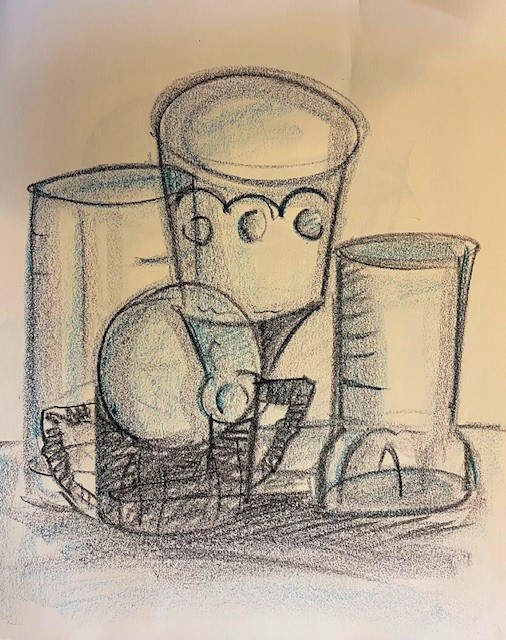
Well, last week as I was trying to clean and reorganize my office/studio, not the closet, I unearthed some of my sketchbooks and several loose drawings from the mid-1960s mixed in with the art paper stacked on shelves in the corner of the room. I have looked at them a few times over the years, but I had to sit down and look at them again until my cleaning time ran out.

Most of the pages were still life crayon drawings in the Cubism style. I was very into Cubism, modern art, and experimental techniques in the '60s. My teacher, mentor, and friend, Floyd Cornaby, encouraged experimentation.

Here is a set of pages from my sketchbook from 1964 or 65. I was 16 when these were done. Each page is 14" by 17".


Commit Acts of Art Every Day!


Friday, April 25, 2025

Committing Acts of Art: Some Things Take Time

 "Not every act of art creates something special, but it does create something. It is the act of art that is important, not the result." Michael L. Goodman

Sometimes it takes time to finish what you start. Committing an act of art may not happen in one sitting at the art table. Multiple acts of art may be committed in a day or begun and finished later. Sometimes, once you start, you have to stop and ponder it for several days. Life has obligations that must be met and often interfere with the completion of an act of art. I have several projects in motion every day, and eventually, some of them get finished. More likely than not, my acts of art are interrupted to do a task for my wife, or a neighbor, or the necessity of pulling noxious weeds and watering the peas.

But the reverse is also a regular occurrence. While pulling weeds in the garden, I often get distracted by an area that needs "art" attention, like arranging particular stones into a carefully balanced tower, or some trailing vine that needs to be woven into a wreath and nailed on the shed wall. 

These pages were started several weeks ago and are finished, as far as I am concerned. What to do with them is a question I haven't answered. They will probably become envelopes to carry letters to my grandsons.


Sunday, March 16, 2025

Enveloping the Word: Creating an Envelope from a Book Page

 "Not every act of art creates something special, but it does create something. It is the act of art that is important not the result." Michael L. Goodman

I tore some pages out of an old art history book yesterday. I do that occasionally, not because I like to destroy books but to get printed papers with interesting designs and colors for whatever art project I feel impressed to work on.

The pages are 12 1/2 inches X  9 1/4 inches. These columns of print look interesting.

Covering the text with a black Sharpie marker is the start of something new.

Adding some lines of color and a few circles in the blank areas takes it a step further.

After adding some spots with a white paint pen. I like this. I could put it in a frame and hang it on a sunny wall, but I have already drawn an envelope pattern on the page, so get the scissors.

It is ready for folding.

It is now an 8 X 5 3/4 inch envelope; just right for a greeting card. This will be the front of the envelope, but I will put the address on the back.

I will write the name and address in the blank spaces. I often use the folded side of an envelope for the address so that the front of the envelope will not be marked and soiled by the postal machinery.


Thursday, February 20, 2025

Enveloping the Word: Valentine's Cards

 "Not every art of art creates something special, but it does create something. It is the act of art that is important not the result." Michael L. Goodman

Three days before Valentine's Day, about ten o'clock in the morning, my wife handed me some red envelopes addressed to the kids and grandkids and asked me to decorate them. She wanted them at the post office before the first pickup of the afternoon (if at all possible). I grabbed some "odds and ends" stickers from the desk and a paint pen and got to work. When I finished, I rushed to the post office and delivered the cards to my favorite postmistress, Cherrie, who weighed and measured them to be sure I had the correct postage. My wife likes to stuff many notes and trinkets in letters to the grandkids. Miraculously, all the letters arrived at their destinations on Valentine's Day.

Here are some I managed to scan before I dashed out the door:


Sunday, February 2, 2025

There Is Nothing Common about Commonplace Books


"Not every act of art creates something special, but it does create something. It is the act of art that is important, not the result." Michael L. Goodman

In a drawer of the cabinet I was cleaning yesterday, I rediscovered my old “scrapbook” from the late 1950s and early 1960s. It contained clippings of newspaper advertisements for movies I had seen or wanted to see along with “artistic” line-illustrated store ads. I collected the ads as references for my drawings and doodles. This was not my journal, I was too lazy at that time to keep one, but a collection of other people’s ideas for my use. Though I did not know it, this was my first commonplace book.


During the 25 years that I taught English, reading, U.S. history, theatre, and French classes, I gave my students a new quotation each day from a writer, artist, actor, or philosopher. They kept the quotes in a notebook. I encouraged them to find other quotes that meant something to them to add to their books and share with the class, but few did. It was just another drudgery [as all schoolwork is] that I imposed upon them. When each school year ended, the students went out the door and the books went into the trash. My attempt to inspire them with a collection of great thoughts from great thinkers failed. It failed because the thoughts and ideas were not what the students found inspiring enough to keep for themselves; they were only important to me. I could not impose my commonplace book upon them.

So, what is a commonplace book? It is not a journal, diary, or personal record of your thoughts, ideas, and events of the day, but a “common place” to keep a collection of other people’s thoughts and ideas for future use or to reflect upon. A commonplace book is a compilation of quotations, poems, knowledge, ideas, song lyrics, anecdotes, proverbs, recipes, lists, illustrations, book titles, words, observations, or anything else one might want to remember [is this list long enough?] either organized by theme or randomly recorded.

Ryan Holiday, author of Discipline is Destiny: The Power of Self-Control, and a commonplace book compiler, remarked, “A commonplace book is a central resource or depository for ideas, quotes, anecdotes, observations and information you come across during your life and didactic pursuits. The purpose of the book is to record and organize these gems for later use in your life, in your business, in your writing, speaking, or whatever it is that you do.”

At a RootsTech family history convention in Salt Lake City, WordPress was handing out small, blank books for taking notes at the conference. I picked up a couple, but I did not use them at the time. After a few years of neglecting the books, I started using them to record the quotations I had scribbled on scraps of paper and stuffed in a desk drawer. They have made convenient commonplace books.


Wednesday, January 15, 2025

Book Arts Mania: Zines


"Not every act of art creates something special, but it does create something. It is the act of art that is important, not the result." Michael L. Goodman

I taught a small class last year for the Cultural Art Society of West Jordan about folded paper books. After they folded and cut several styles of these books, I showed how the format has been used to make zines. I showed them one I made. I printed thirty copies and left them on Trax train seats and other places I have frequented since then. Someone may have picked them up and kept them. I suppose many of them ended up in the trash bin.


Tuesday, December 31, 2024

Enveloping the Word: 2024 Christmas Cards

"Not every art of art creates something special, but it does create something. It is the act of art that is important, not the result." Michael L. Goodman

I began decorating my Christmas cards at the latter end of November. I experimented with various designs initially and settled on one or two variations as I progressed. The cards that went to France, England, and Scotland were done first and mailed before December. The next batch went to cousins and friends strewn throughout the United States followed by those who live in Utah outside the Salt Lake Valley. The last two mailings were to those in the valley ending with those in West Jordan. I saved the West Jordan cards till last because they would take the least time to arrive at their destinations. I have two post office clerks who keep my West Jordan letters in-house so they are delivered the day after I post them. I sent out 82 Christmas cards with decorated envelopes this year. These are samples of the cards: